Territory
Claims, takeovers and fade
Territory is street-scale. Every claim is either something you physically ran, or ground you enclosed by closing a loop, and the two behave differently.
The map underneath is divided into small hexagonal cells. A claim always resolves to whole cells, and every hex you see coloured in on the map is one player’s current claim on that patch of ground.
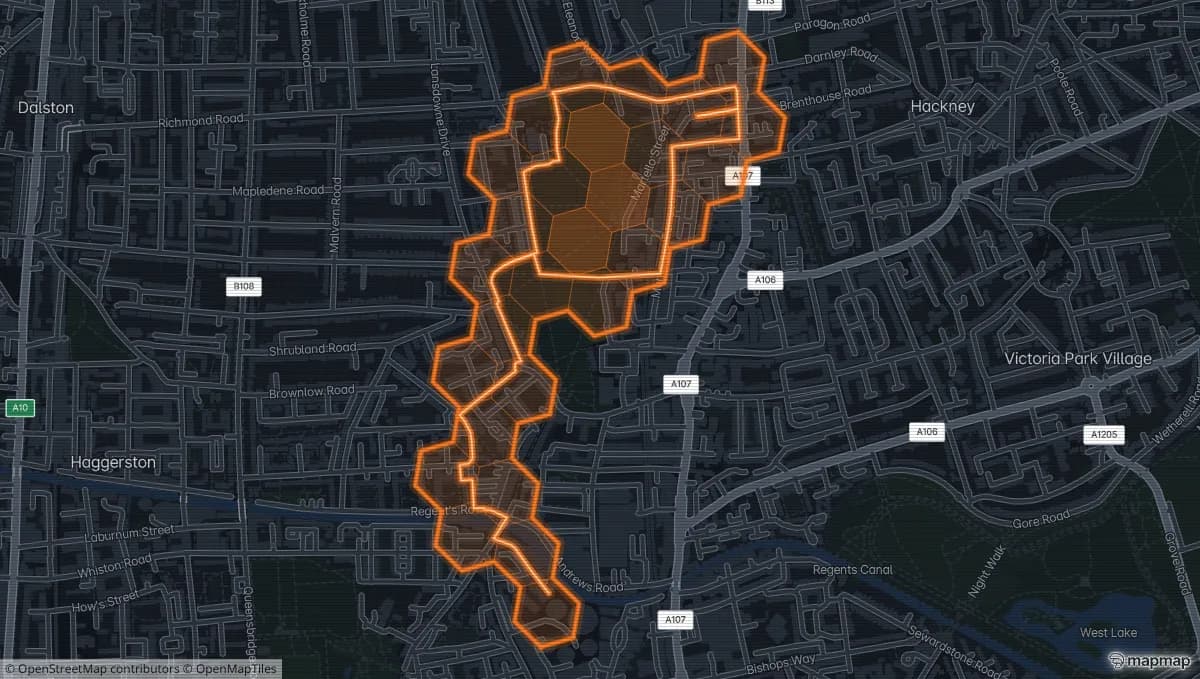
Path claims vs loop claims
A path claim is a street you physically covered. It is a hard claim: nobody can lasso it from the outside, only running it themselves takes it.
A loop claim is ground enclosed when your route returns to where it started. It is a soft claim: it belongs to you until anyone else, running or looping, touches it again.
Takeovers: last touch wins
Whoever claimed a cell most recently owns it. Run through a rival's street and you take it, no further maths involved.
The one asymmetry that matters: a path claim can only be beaten by another path claim. A loop can never lasso streets someone physically ran. That closes off the obvious exploit of drawing one huge ring round a borough and calling it yours, since the streets inside it stay owned by whoever actually ran them.
Who takes what: the whole rulebook in one table
| You arrive by… | Their claim is… | Result |
|---|---|---|
| Walking their street | A walked street | You take it. Last walk wins. |
| Walking through their loop fill | Loop fill | You take it. Feet beat fill, always. |
| Enclosing them in a loop | A walked street | They keep it. A loop never takes a walked street. |
| Enclosing them in a loop | Loop fill | You take it. Newest loop wins the fill. |
A worked example from a real day of play: one player walked a nine-kilometre ring around town and the loop filled everything unclaimed inside it, more than two hundred hexes in one walk. Two rivals held a small pocket of walked streets in the middle: the ring could not touch those, so their pocket sat untaken inside his sea of fill. The next day either rival could stroll any street inside that ring and carve fill out of it, hex by hex. Loops grab big and hold weak; walked streets are the only hard currency.
How long does a claim last?
Nothing is held forever without upkeep. Path claims last 30 days, loop claims last 14 days, then the cell fades back to neutral. Re-running your own streets re-arms the clock, so holding ground is really about staying consistent, not about one big session.
The map panel keeps score of that consistency: your combo counts consecutive days with at least one claim, and an amber line warns you when hexes are within three days of lapsing, with a click to jump straight to them.
Claim ground nobody has ever claimed and it is recorded as a first in recorded history, street by street, with a dated certificate you can share or keep. Firsts are permanent: someone can take the street, but never the first.
Ground marker gear, a Turf Tag or a Line Beacon, can extend both windows by a few extra days, up to a cap. The bonus is locked in from whatever marker you have equipped at the moment you claim, so changing gear later does not retroactively change ground you have already taken.
Can other players see where I live?
No. Once you have a saved home location, claims within roughly 250 metres of it are dropped before they ever become public territory. Nobody, rival or otherwise, sees your street-level claims that close to home.
See how held cells roll up into a scoreboard on leaderboards.